Suez Maru Families and Research Association


Norman Edward Lawe
25 September 1909 - 29 November 1943
Norman Edward Lawe
Royal Air Force Volunteer Reserve
Volunteer Reserve
Rank: Leading Aircraftman
Service No: 762154
Home Town: Stafford
Nationality: English
Family:
Father: Bruce Edward Lawe
Mother: Florence Louisa Lawe
Norman Edward Lawe was born on the 25th September 1909, in the Herne Hill area of London, he also had a twin sister called Ivy Grace Law. Their parents appear to have been fairly affluent for the time, Norman’s father Bruce worked as a Clerk for the Royal Army Clothing Department in Pimlico, although on their 1911 Census he gave his occupation as “Writer”. Bruce’s role for the Army may have required him to relocate as by the 1920’s Norman is known to have attended a school in Stretford, Manchester – again this would be only a temporary location as he would later be based in Staffordshire.
By 1939 Norman and family were now living in Stafford in the outlying suburb of Burton Manor, Norman’s father was now Chief Clerk at one of the Engineering Works in the town. Norman appears to be the only child still at home at this time, he would now be working for Williams Deacon’s Bank at their branch in Uttoxeter, although it is also noted on his record that he had joined the Royal Airforce Volunteer Reserves, and was currently an Aircraftman Grade II. Later he would be a Leading Aircraftman with Service Number (762154).
Norman is known to have been sent out to the Far East, he would be captured by Japanese Forces during the Battle for Java, and was taken prisoner on March 20th of 1942. Norman’s current information would be relayed during a radio broadcast from early May of 1943.
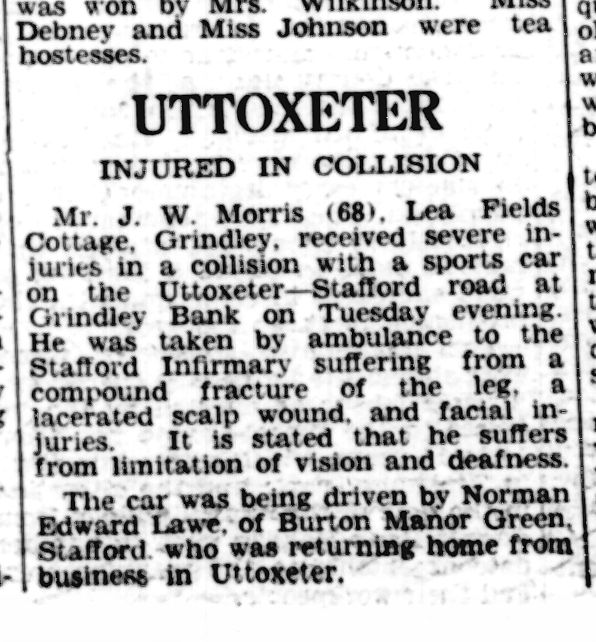
Despite his surname being misspelt as ‘Lowe’ it is obviously related. Norman’s family appear to have relocated again during 1943, and he had obviously not received their new address.
A second shorter report was also carried by the ‘Stafford Newsletter’ on the same date.
Norman is later unfortunately known to have been amongst the Japanese prisoners to have been transported via the Suez Maru. The Japanese transport vessel would leave from Ambon on the 25th November 1943. Prior to this Norman is likely to have been engaged at one of the various Japanese work-camps in this area. Four days into its voyage the ship was attacked by US Forces, unaware that it was being used for prisoner transport. Sadly Norman was reported lost at sea, following the attack. His date of death was given as the 29th November 1943. Norman’s passing does not appear to have been confirmed until sometime later. A further news item appeared in early February 1944, but again used his former home address in Stafford, which would appear to be incorrect given the prior information.
Norman is known to be commemorated in several locations. Firstly within a remembrance book at his old Grammar School in Stretford where is believed to have been a pupil from 1921 to 1926.
In addition to this Norman is also remembered via his role at the bank. Following various acquisitions the Williams Deacon’s plaque was moved to a Manchester branch of the Royal Bank of Scotland, where it is noted that he joined the bank staff after leaving school in 1926, and remained with them until he joined the R.A.F. in September of 1939. Norman had also been mentioned in a 1930 edition of the Banker’s Magazine whilst working at Uttoxeter, as he had successfully completed some additional qualifications during that year.
The Story of Norman E. Lawe
According to a further R.A.F. archive record Norman had actually enlisted via their Civilian Wireless section as a reservist during August of 1939. Norman is also commemorated in Stafford, where he is listed on a memorial plaque for World War II, alongside others from the town. Prior to this being installed his name had also been noted in the book ‘Stafford at War 1939 – 1945’ by Nick Thomas. Norman is also listed in the book ‘Unsung Heroes of the Royal Airforce’ by Les and Pam Stubbs.
Norman’s details are also recorded within the Commonwealth War Graves Commission records.
Norman’s details as listed within an original wartime casualty report. Norman is the only serviceman with a Stafford connection known have been aboard the Suez Maru.
Far East PoW Japanese Index Card
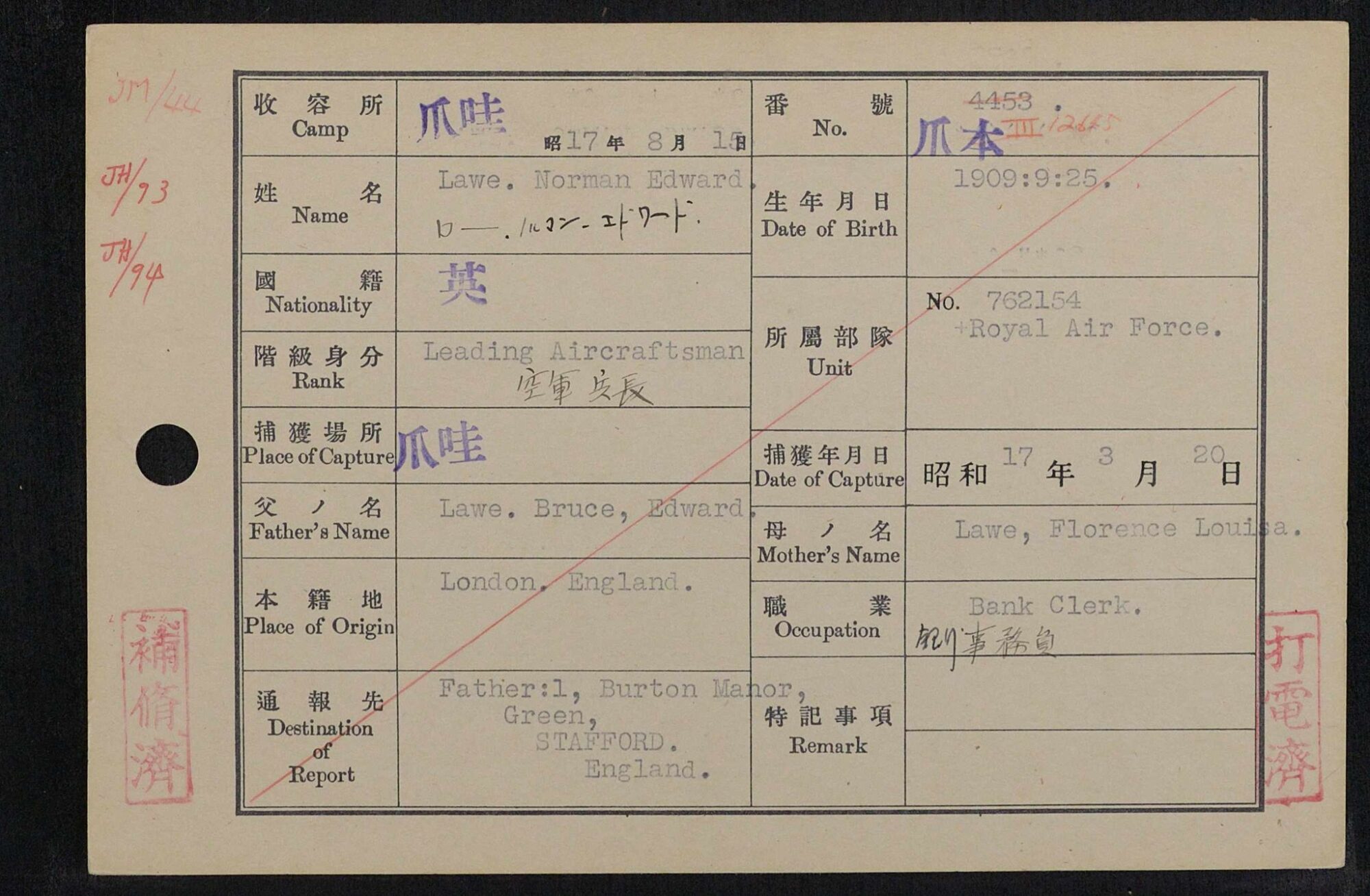
The front of the card (except English sections)
Camp – the three vertical lined characters – JAVA (1942 (17th year of the the emperors reign) August 15th)
Nationality given as British/English
Place of capture – JAVA, and another character,
PoW number: The box marked No. is the PoW number a man had. I think the crossing out denotes when the PoW was transferred (for the SM men) to the Moluccas.
So I think originally at Java Base, then [moved to] Java Camp III (3). Camp (3) beling Ambon.
The two red vertical stamps on either side of the main box have been translated as ‘Supplement’ and ‘Telegraphed’ – relates to the ‘processing’ of the deaths, sending (via telegram)
The red diagonal line across the whole front of the page is a rather callous way to indicate the person was deceased.
Image (c) TNA WO345
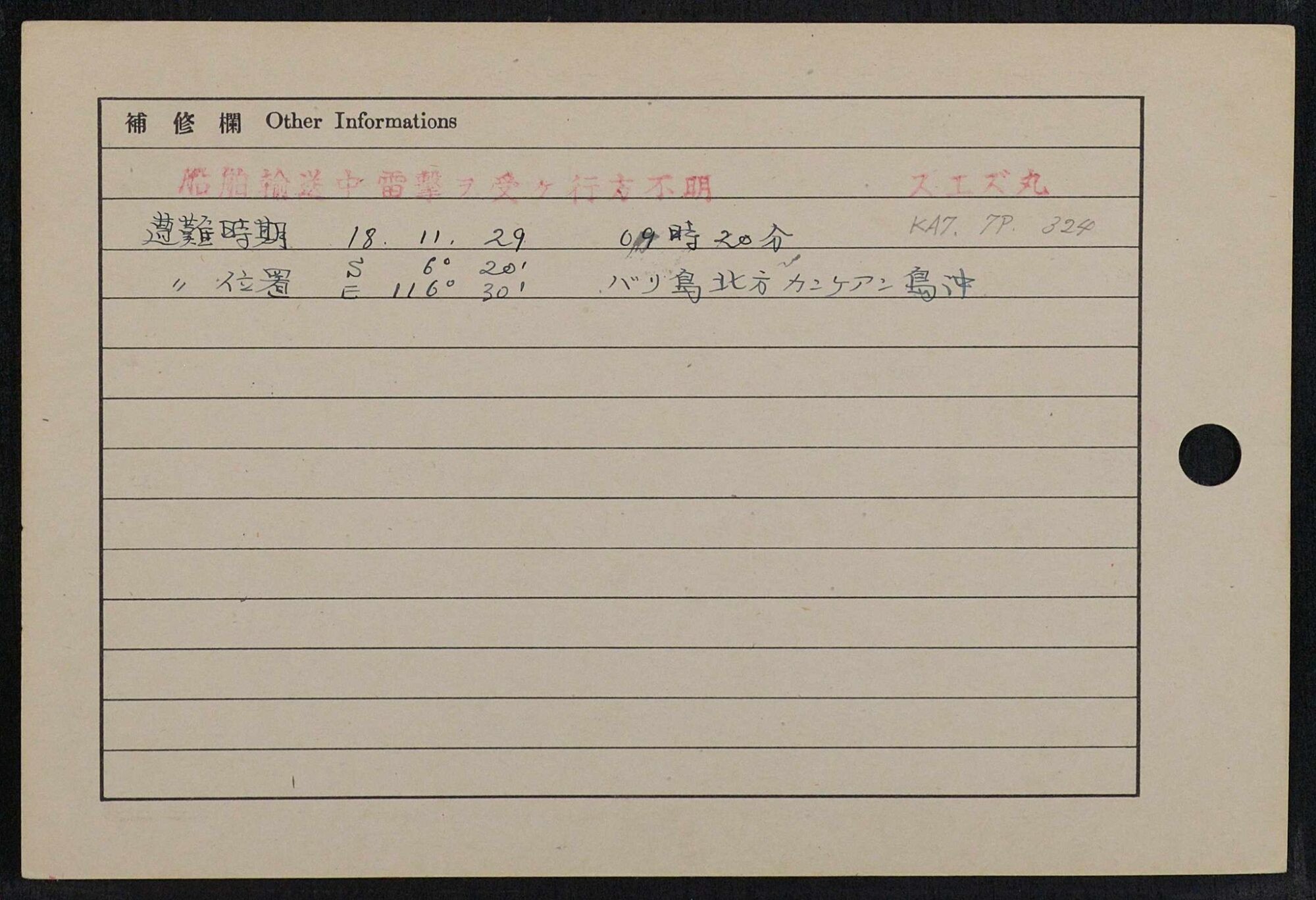
Reverse of the index card
Top line: Other Informations noted that a stamp was made for the first section of red text, and a smaller (4-character) stamp for the end of the same line; the Japanese text translated-
2nd line: The ship was on its way to deliver the prisoners when it was hit by a thunderstorm. [4 characters after small gap] Suez Maru
3rd line: When the attack happened. [date – 18th year of emperor’s reign, 11th month, 29th of the month: 1943, November 29th] 18.11.29 [time of sinking] 09:20 [KA text here – unclear what this refers to]
4th line: [first text, then coordinates] Where the attack happened S 6 20′ E 116 30’ [description of location of sinking] North of Bali Island near Kangayan [Kangean] Island.
Some reverses have additional information, but for the vast majority (of Suez Maru men), their card reverses are identical
Image (c) TNA WO345
Are You Related to Norman Edward Lawe?
If you are a relative, or have additional information, photographs, or family recollections to share, we would be honoured to hear from you.
This archive continues to grow through the generosity of families who wish to preserve the memory of those lost.