
The Suez Maru Story
Introduction
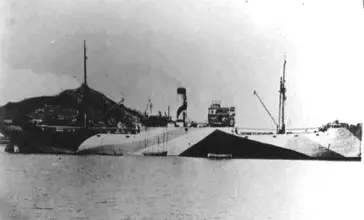
Suez Maru was one of many Japanese ‘hellships’ as they were known, that crisscrossed the far east seas, carrying war supplies, cargo, Japanese servicemen and, unknown and concealed, they also transported Allied prisoners of war of the Japanese. Against the Geneva Convention these ships were unmarked by the identifying red crosses to indicate such persons were aboard. The SS Suez Maru was a civilian coal ship, conscripted into Japanese war service, and captained by Tamaki Shirakawa. The ship had been involved in an Allied torpedo attack in October 1943, when several ships in its convoy were sunk, which led to one of the lifeboats still being missing by the time it docked at Ambon in late November 1943. This attack had sunk a second ship which was due to sail in the sick draft convoy back to Java, resulting in the planned evacuation of over a thousand sick men from these islands being reduced by almost half. Some surviving FEPoW’s of the Moluccas later spoke of a desperation to get aboard the Suez Maru ,however history would show that not boarding saved their lives
The Sick Draft
The men of the Suez Maru were a sick draft of 550 English, Dutch, Welsh, Scottish, Irish and one New Zealander men. Almost all came from the capitulation on Java in March 1942, they later, by a series of ill-fated circumstances, found themselves spread across several hellships bound for the Moluccan Islands of Ambon, Haruku and Ceram. Of the thousand men landed at Ambon and sent to Liang camp (the Liang Marchers), a total of 297 of them would later board the Suez Maru, adding an additional thirty percent mortality to the already high rate of that island, when the ship was sunk. Some of the men aboard had been transported from the neighbouring island of Haruku – a mirror image island of palm trees, PoW built airstrip and suffering.
As the Suez Maru left Ambon on 25 November 1943, bound for Surabaya on Java, the Allied FEPoW’s were cramped into number three and four holds, at the stern of the ship. Over the course of the voyage, in common with other hellships, conditions were atrocious, there was little room, food, water or hygiene facilities. About twenty FEPoW’s had been left on deck, on stretchers. When they, and others in the holds, passed away their comrades were ordered to simply throw them overboard. The ship also carried two hundred wounded soldiers of the Imperial Japanese Army, who occupied the foremost holds (1 and 2).

Suez Maru Crew
The Suez Maru was sailed by a conscripted civilian crew commanded by Shirakawa, with only one escort assigned, a minesweeper, named only W12, commanded by Captain Osamu Kawano. A Transport Commander, Lieutenant Masaji Iketani, had been promoted to oversee ‘prisoner welfare’. A medical team of orderlies were overseen by Medical Officer Eto – to tend only Japanese casualties. Two days prior to the Suez Maru’s departure from Ambon, an American submarine, the USS Bonefish, commanded by Captain Hogan, left port in Fremantle on reconnaissance in the Celebes area, on its second war patrol, searching for enemy shipping. During 28 November, the Bonefish sighted the Suez Maru and W12, both were issuing trails of thick, black smoke from the funnels. The Bonefish tracked the small convoy, then submerged in twilight to await dawn to attack. W12 had, meanwhile, spotted a submarine, and left the Suez Maru alone to search, but could not locate it.

Timeline of 29 November 1943
5am: Bonefish surfaces and tracks the Suez Maru. W12 had overtaken her in the night and now slows as the Suez Maru catches up. All the while the Bonefish prepares torpedoes, stalking these targets.
9am: normal work is beginning on deck of the Suez Maru, three Japanese crew amble to a deck store to collect paint and tools for maintenance work. A few prisoners of war are permitted on deck to ablute overboard. In the galley below the ship’s crew enjoy a good breakfast.
9.17am: (1hr log time error due to timezone) – Torpedoes loaded, range calculated, the Bonefish fires a barrage of four projectiles in a matter twenty-eight seconds.
It takes just over a minute for the Bonefish crew to see and hear the first impact, and a further seven seconds to record the second hit. Two torpedoes have missed. The Suez Maru stops dead in the water, and the stern sinks immediately. The first impact killed all prisoners in hold four, and those in hold three try desperately to escape.
The second impact broke the ships spine. It splits across its middle, the sinking stern pulls the bow out of the water at thirty degrees.
Japanese captain, Shirakawa, declares all is lost and gives the order to abandon ship. The crew begin to lower lifeboats, scrambling to save themselves. They do not help the prisoners escape the ship and no prisoners are permitted in the lifeboats.
c. 9.40am: The Suez Maru bow rises vertically out of the water, it bobs for a moment then is pulled under as the stern drags the ship down to the bottom of the sea, taking c. 300 prisoners with it.

Around 250 (some witnesses recalled seeing 280-300) prisoners of war float on the open sea, clinging to flotsam from the sunken ship. They are already weak from long captivity and escaping the sinking ship, and they have no provisions. Meanwhile, the Japanese gather on lifeboats, life rafts, life planks and wear life jackets as they move around the chaotic oil-slicked scene, rescuing any Japanese still in the water.
The escort W12, leaves the survivors and circles widely, dropping depth charges, searching for the Bonefish, but it has left the immediate area, however, some W12 depth charges come close to contact. The W12 hunt for the Bonefish continues for around five hours, while the prisoners struggle in the sea. The Japanese abandon life planks for the increased security of the lifeboats, and these discarded planks are used by the prisoners. Hours later, W12 returns to the scene, and begins rescue operations – Japanese only. Any prisoner trying to climb up is pushed and kicked back down into the sea.
c. 5pm: about two hours after operations started, all Japanese are deemed to have been rescued.
Not one prisoner of war has been saved. Meanwhile, naval Captain Kawano of the W12 discusses the prisoner’s situation with, by now rescued, army Transport Commander Iketani. They also consult rescued civilian Captain Shirakawa of the Suez Maru, but he is apparently dismissed from further discussions, he would later insist he knew nothing of the subsequent war crime. Kawano and Iketani however, are incensed, and seek revenge for the sinking and loss of some personnel. Iketani briefs Kawano that his army superior, commander of Moluccan PoW camps, Colonel Anami, previously instructed him that prisoners could be killed if they could not be rescued, in some remarkable foresight. Kawano agrees immediately and summons Gunnery Officer Daiso Yatsuka. Kawano orders Yatsuka to muster twenty riflemen on the deck at the gunwale, and mount two machine guns on the lower bridge deck. These conversations are overheard by IJA Yoshio Kashiki. What followed was witnessed by Kashiki and many others who later gave sworn statements. Meanwhile, the prisoners in the sea gathered together, some in the remaining, now vacated, lifeboats, some on life rafts. They form a long line of between 250-300 men. They have been adrift since 9.20 that morning, and by now, around eight hours later, they are desperate.
c. 5.30pm: Captain Kawano gives the order to commence firing on the prisoners in the water. The prisoners have no idea what is about to happen and gather, thinking the approaching W12 is finally taking them aboard in rescue. Prisoners nearest the W12 reach out, as the machine guns start firing.
Prisoners fall in all directions, witnesses later described the horrific scene as ‘unbearable to watch’. Many did watch, however. On hearing the machine guns and screams they rushed to the gunwale to look overboard. Most are repulsed. In later reports, some go into gruesome detail of what they saw, others said they simply sat down on the deck and covered their eyes and ears. Witnesses later stated that they saw some prisoners, realising there could be no escape, standing up on lifeboats and rafts, exposing their chests as targets in acts of defiance and bravery. The prisoners were heard shouting out, but the japanese could not understand their English and Dutch words, as they were cut down.
Any miraculously still alive after the machine gunning were individually targeted by rifle, and shot. It took over an hour and a half to ensure every single prisoner was dead, the final shots ringing out sporadically as the massacre was completed. Witnesses later recalled that the sea turned red — the blossoming pool surrounding the bodies of hundreds of defenceless prisoners.
c. 7:30pm Captain Kawano is finally assured every last prisoners of war is dead. W12 rams the lifeboats, ploughing through the debris and bodies and leaves the area, its course set for Java.
December 1943 – the Lie Begins
W12 arrives at Batavia 1/12/43 (Surabaya, now reportedly mined by the Allies).
Kawano immediately conspires with Iketani, and commander of the Java PoW camps, Colonel Saito, to falsify war records.
This record, dated 2 December 1943, reads that the ‘…enemy torpedoed the Suez Maru,…’ and that, ‘…because of the need for strict security, all the prisoners were kept locked in the holds, so they all went down with the ship,’ and that, ‘…no survivors could be found despite rescue attempts…’.

January 1944 onwards – Families told the news (omitting any detail)
A communication received in Geneva by the International Red Cross, was telegrammed to London. It contained a list of names and service numbers of ‘British psow perished when the ship on which they were transported from Djawa to some other camp was torpedoed by the enemy 29/11/43.’
The British Suez Maru families received letters, ours dated 31 January 1944. These letters used the template of words telegraphed by the Japanese. The explanation is 76 words. The lack of information, lack of clarity of events, and use of the word enemy ensured prolonged confusion over what in fact had happened. Nothing further would be known about the sinking and subsequent war crime, until 2 June 1949. The Suez Maru families would know nothing at all, for fifty more years.
June 1949 – the Lie is revealed, thanks to Yoshio Kashiki
Five and a half years after the sinking, Yoshio Kashiki, the wounded Japanese servicemen aboard the Suez Maru sinking, now suffering from tuberculosis and in a convalescent hospital, wrote several letters; first in Japanese, then translated into English via a friend, to SCAP GCHQ in Tokyo.
His short letter began, ‘I wish to report to you the facts of a prisoner murder case…”
By now, there were only four war crime investigators ‘mopping up cases’ at 2 Australian War Crimes section, SCAP, and Captain Jack Sylvester became the investigating officer of this ‘new case’. He wasted no time. Kashiki’s letter was dated 2 June, and by 13 June Captain Sylvester was questioning the captain of the Suez Maru, Tamaki Shirakawa. The main instigators took a little longer to track down. Captain Sylvester questioned W12 captain, Osamu Kawano on 7 July 1949, and the transport commander in charge of the ‘welfare’ of the prisoners of war abroad the Suez Maru, Masaji Iketani, on 14 July. The latter was found despite having changed his name to Masaji Koshio.
Captain Jack Sylvester – the investigation begins
By late August 1949, Captain Sylvester had questioned dozens, taken twenty-two sworn statements, amassed documents and compiled a detailed report on the progress of the investigation into the case. Titled ‘Massacre at Sea of Allied P. W. – 29 November ’43’ the report listed names, addresses and statements of the captains and crew of the Suez Maru and W12, as well as many others involved in covering up this war crime. Sylvester’s report recounts the confessions in their sworn statements, of Iketani, Kawano and Yatsuka, the involvement of others, and concludes (here underlining his own findings) that there;
‘…is sufficient evidence to constitute a prima facie case against Kawano, Iketani and Yatsuka, and other subordinate officers and crew of the Minesweeper W12… to bring these participants to trial.’
Opportunity for Justice
Meanwhile, the FEC (Far East Commission) in London, had suggested an end date ‘if possible’ for the Far East War Crime Trials.
The 1946 trials were considered to have dealt with the ‘main’ perpetrators, and various deals had been struck to protect Emperor Hirohito and others from prosecution. There was also compelling evidence that the further war crimes were investigated, the more deeply they exposed the culpability of the command structure and that apex of command.
To surviving veterans of the far east theatre and former FEPoWs it was unthinkable that investigations should simply cease. But, cease they did and despite a request to the very highest levels of British Government, the ‘Suez Maru’ case would be again hidden, for a further fifty years.
Opportunity for Apology – see Campaign pages (coming soon)
