Jack Frith
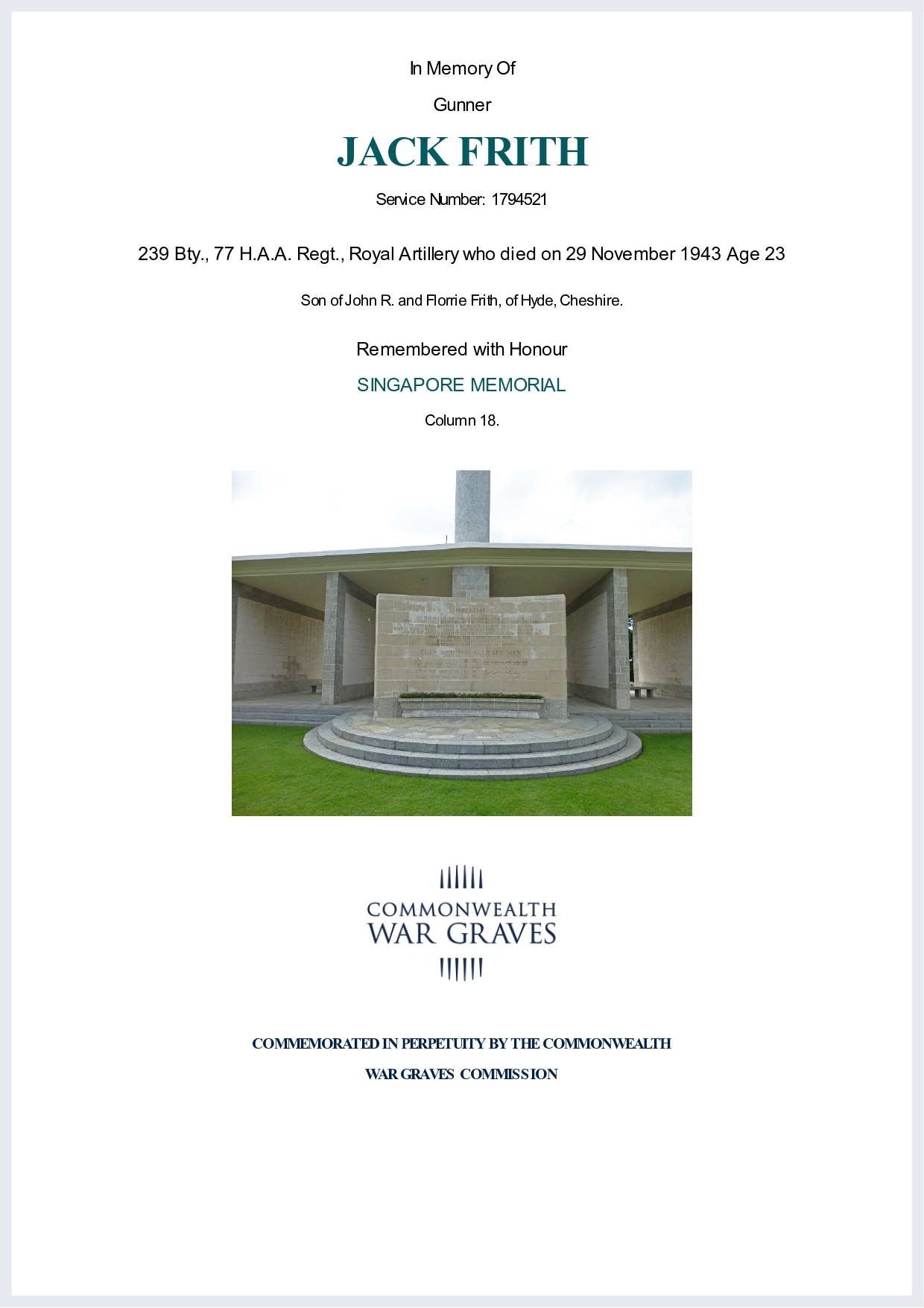
Rank: Gunner
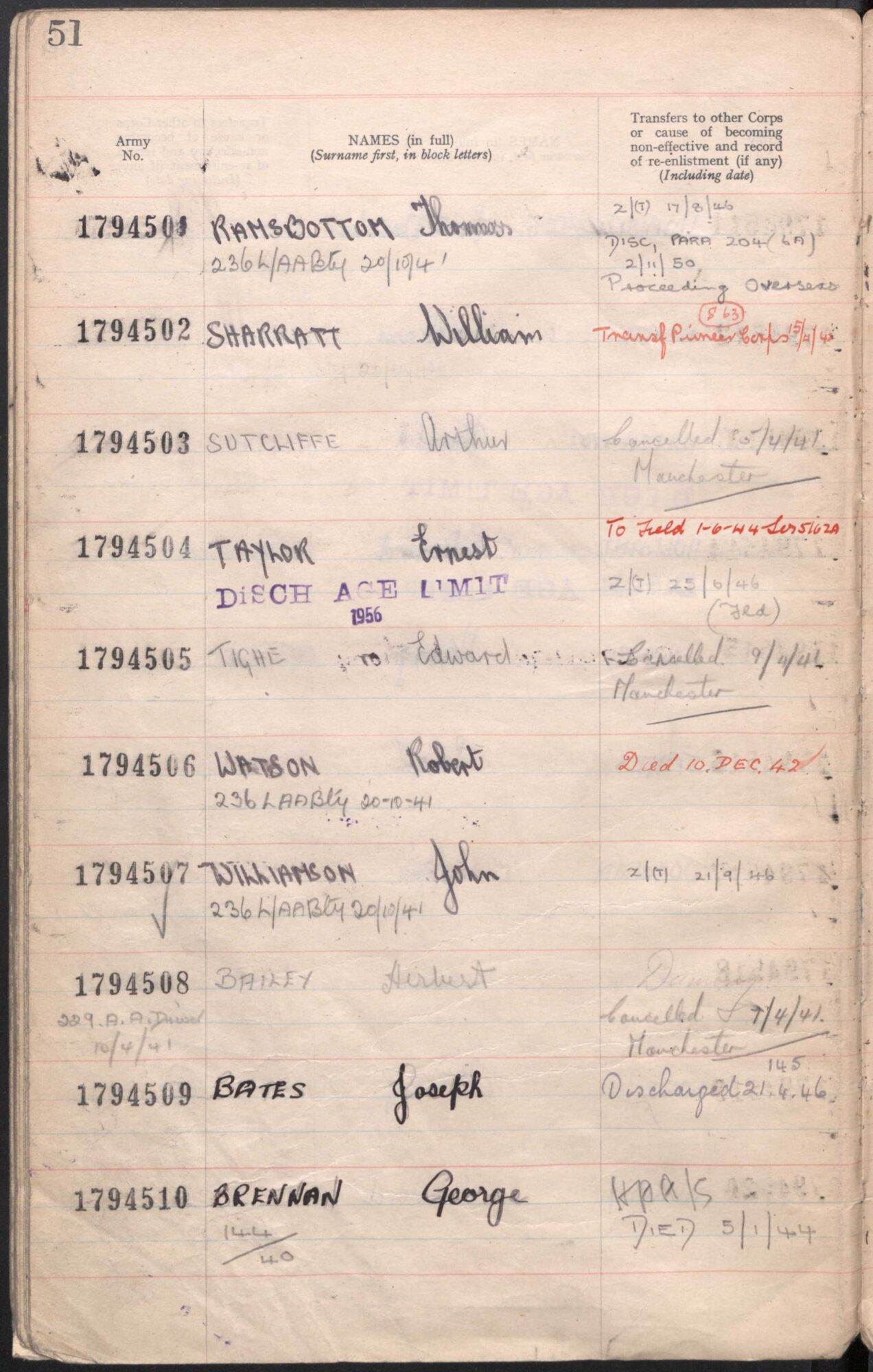
Service No: 1794510
Home Town: Hyde, Cheshire
Nationality: English
Family:
Father: John Robert Frith
Mother: Florrie Frith
My uncle Jack Frith, by Alastair Frith.
I didn’t get to meet my Uncle Jack as he was killed in the Suez Maru atrocity. My overwhelming feeling even as a small child post WWII, was of a man who had a great love of life and fun, with quite a hint of mischief. This was felt alongside an enormous sense of loss and sadness that left a huge hole in my family’s lives. I know that Jack, my father (George) and my grandparents (John and Florrie) would be highly pleased and impressed that, despite the establishment’s efforts to hide their cowardice, this atrocity is finally seeing the light of day, and it owes recognition to Kashiki, and all those fighting for recognition and justice for these heroes.

Jack Frith – by Jacquelyn Frith
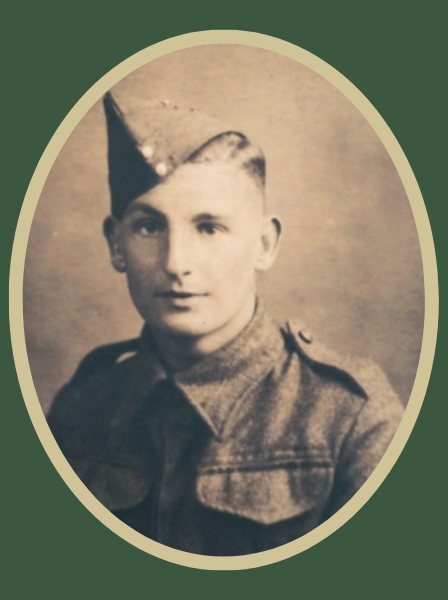
The family of Frith’s mourning the loss of Jack included his mother, Florrie, and father, John, elder brother George, and sister, Gladys and all the family descended from them. This picture of him in uniform was hung over the fireplace, next to a picture of his brother George in his uniform, at John and Florrie’s home. The loss of Jack percolated through the family, and something of this grieving and grievance has been passed generation to generation.
The last person to have known him, Gladys’ daughter, Carole, passed in 2020, but she remembered being carried on his shoulders, sharing sweets and laughter. Jack’s arrival had been a ‘happy accident’ for his parents we’re told, as the older children were born just before and between his father’s service in WWI. Jack arrived after two years of peacetime calm in 1920.
When the baby of the family signed up in April 1941, he became Gunner Jack Frith, of 239 Battery, 77th HAA, Royal Artillery. He had been working in essential war work, making munitions at the ICI Rexine works in Hyde with his father, until hearing one of his best friends, Harry Booth, was lost aboard HMS Bonaventure when it was torpedoed by an enemy Italian submarine, he decided to sign up. Jack’s character, I’m told, was quite bold, he was strong-willed and not afraid of speaking his mind. His brother had said he was glad Jack was not a prisoner of the Japanese for long, as he would have pushed back. That he was not a FEPoW long was, sadly, a misconception brought about by a delay in hearing of his status as a PoW of the Japanese, and not long after, learning of his death. The family knew Jack was sent overseas in December 1941, and were then told he was missing, but heard little more for over a year, until spring 1943 when they were informed he was a prisoner ‘in Japanese hands’, in the NEI.
His brother, George, my grandfather, served in the RAF and after being posted around the UK (including preparing Spitfires for D-Day), he was, after learning of the loss of his brother in early 1944, posted to India for the remainder. George then saw direct action against the japanese, and he learnt first-hand what a cruel enemy they were.
He would not speak of them post-war. Although the family has a close connection with Jack’s loss, there are not many physical items. There’s a few newspaper clippings that tell the (incomplete) story of Jack, a diary of 1942, which he was never able to keep, contained within a leather document folder, and his medals — awarded posthumously, and a letter.
The newspaper clippings published within a few months of each other.
One precious handwritten letter to the family has survived. Written aboard the Empress of Australia, in December 1941 and posted home from South Africa. Jack wrote of his love for his family, his joy at being an uncle, and of his concern when he would see them all again. In his own words, he wrote of the war needing ‘to be finished’ but, that he feared it could be ‘three years’ before he would see them. He asked his brother how ‘life is treating you, kid?’ and ‘not to worry’ that he would ‘look after himself’. Jack finished the two-page letter with a ‘cheerio’ from ‘your ever loving brother’ and planted fifteen kisses standing to attention in three rows of five underneath. It’s a touching indication of the man he was. He could apparently be found, jumping around the house, dancing to the latest music on the wireless, he was sometimes told off by his mother for swearing, and he would often take his girlfriend Irene, out to the cinema. He was full of personality, and was (and is) much loved.
Cruelly, the family would receive a hand-written note from Jack, (now lost) over a month after his death, on December 31st, 1943, which stated he was ‘fit and well and working for pay.’ They must have felt enormous hope, only to be told the terrible news a month later on January 31st, 1944.
There are several heartbreaking newspaper clippings in remembrance, which speak on the deep sorrow felt by our family, but, I often copy the lines penned in one clipping by my dear grandad, Jack’s elder brother;
Silent Thoughts,
True and Tender,
Just to Show,
We Still Remember
Unwritten Letters to Spring Street
Book written about Jack Frith and the Suez Maru atrocity, the title references the letters he could not write to home at 13 Spring Street.
Published 2020
see website http://www.unwrittenletterstospringstreet.co.uk
On Prisoner of War Ship – Mr and Mrs J.R. Frith, 13 Spring Street, Hyde, have received news that their son, Gunner Jack Frith, R.A. (23) was killed on November 29th, 1943, when the ship on which he was being taken by the Japanese from Java to another prisoner of war camp was sunk. Gunner Frith sent an undated card to his parents, which they received on December 31st, telling them that he was fit and well and working for pay. Before joining the Army three years ago, Gunner Jack was employed at ICI (Rexine). He was posted as missing 25 months ago and reported to be a prisoner eight months ago. He has an elder brother, George, who is in the RAF. Picture ©Frith Family
Prisoner in Java – Mrs Frith*, of 13 Spring Street, Hyde, has been informed by the War Office, that her son, Gunner Jack Frith, RA, is a prisoner in Java. It is 12 months since Mrs Frith heard that her son was missing, and this is the first intimation she has had as regards his captivity. Gunner Frith was educated at Green Street School, and was formerly employed by the ICI (Rexine). He is 22 years of age, and has an elder brother, George, serving in England in the R.A.F. (*corrected spelling) Picture ©Frith Family
Letter sent to Jack’s parents, my great grandparents, 31 January 1944 ©Frith Family
FRITH J inscribed at Kranji CWGC ©Frith Family
Unwritten Letters to Spring Street by Jacquelyn Frith
The front of the card (except English sections)
Camp – the three vertical lined characters – JAVA (1942 (17th year of the the emperors reign) August 15th)
Nationality given as British/English
Place of capture – JAVA, and another character,
PoW number: The box marked No. is the PoW number a man had. I think the crossing out denotes when the PoW was transferred (for the SM men) to the Moluccas.
So I think originally at Java Base, then [moved to] Java Camp III (3). Camp (3) beling Ambon.
The two red vertical stamps on either side of the main box have been translated as ‘Supplement’ and ‘Telegraphed’ – relates to the ‘processing’ of the deaths, sending (via telegram)
The red diagonal line across the whole front of the page is a rather callous way to indicate the person was deceased.
Image (c) TNA WO345
Reverse of the index card
Top line: Other Informations noted that a stamp was made for the first section of red text, and a smaller (4-character) stamp for the end of the same line; the Japanese text translated-
2nd line: The ship was on its way to deliver the prisoners when it was hit by a thunderstorm. [4 characters after small gap] Suez Maru
3rd line: When the attack happened. [date – 18th year of emperor’s reign, 11th month, 29th of the month: 1943, November 29th] 18.11.29 [time of sinking] 09:20 [KA text here – unclear what this refers to]
4th line: [first text, then coordinates] Where the attack happened S 6 20′ E 116 30’ [description of location of sinking] North of Bali Island near Kangayan [Kangean] Island.
Some reverses have additional information, but for the vast majority (of Suez Maru men), their card reverses are identical
Image (c) TNA WO345
If you are a relative, or have additional information, photographs, or family recollections to share, we would be honoured to hear from you.
This archive continues to grow through the generosity of families who wish to preserve the memory of those lost.